
Behavioral Market Simulation
A working research platform for studying how people make financial decisions when market conditions change.
Participants trade in a controlled, simulated market while the BMS records each decision, not just the final profit or loss.
- Real, functioning software
- Programmed market events
- Every decision recorded
Explore the Actual Simulation Interface
A real frame from the BMS software. The numbered labels identify each part of the participant interface.

Watch the Behavioral Market Simulation in Action
This video demonstrates simulated platform activity. It does not show QU-001 participant results.
Inside a Session
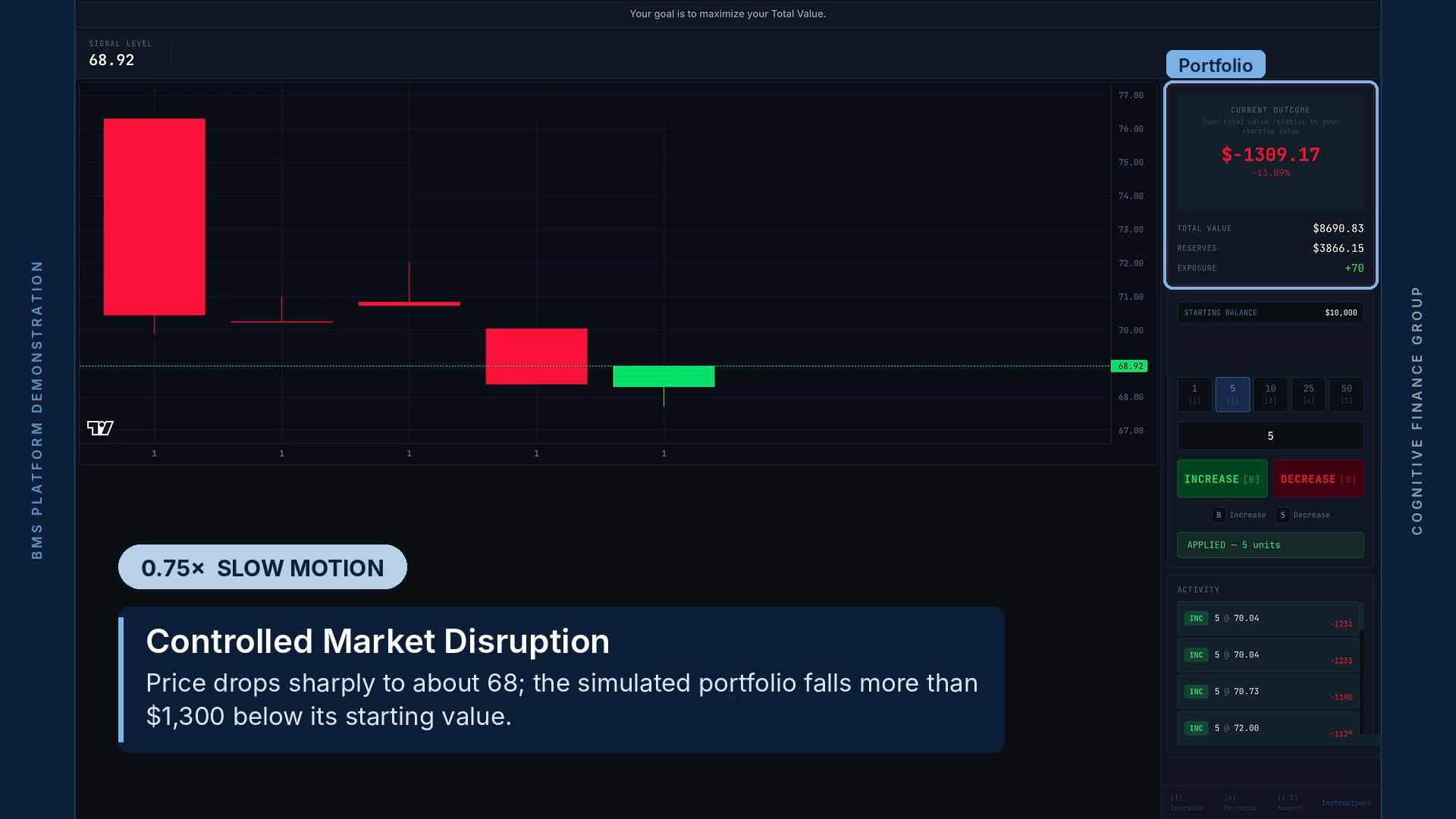
Market Disruption Scenario
A programmed price event, shown in slow motion. Price moves sharply on the chart while the participant sells, and each sale appears in the activity log.
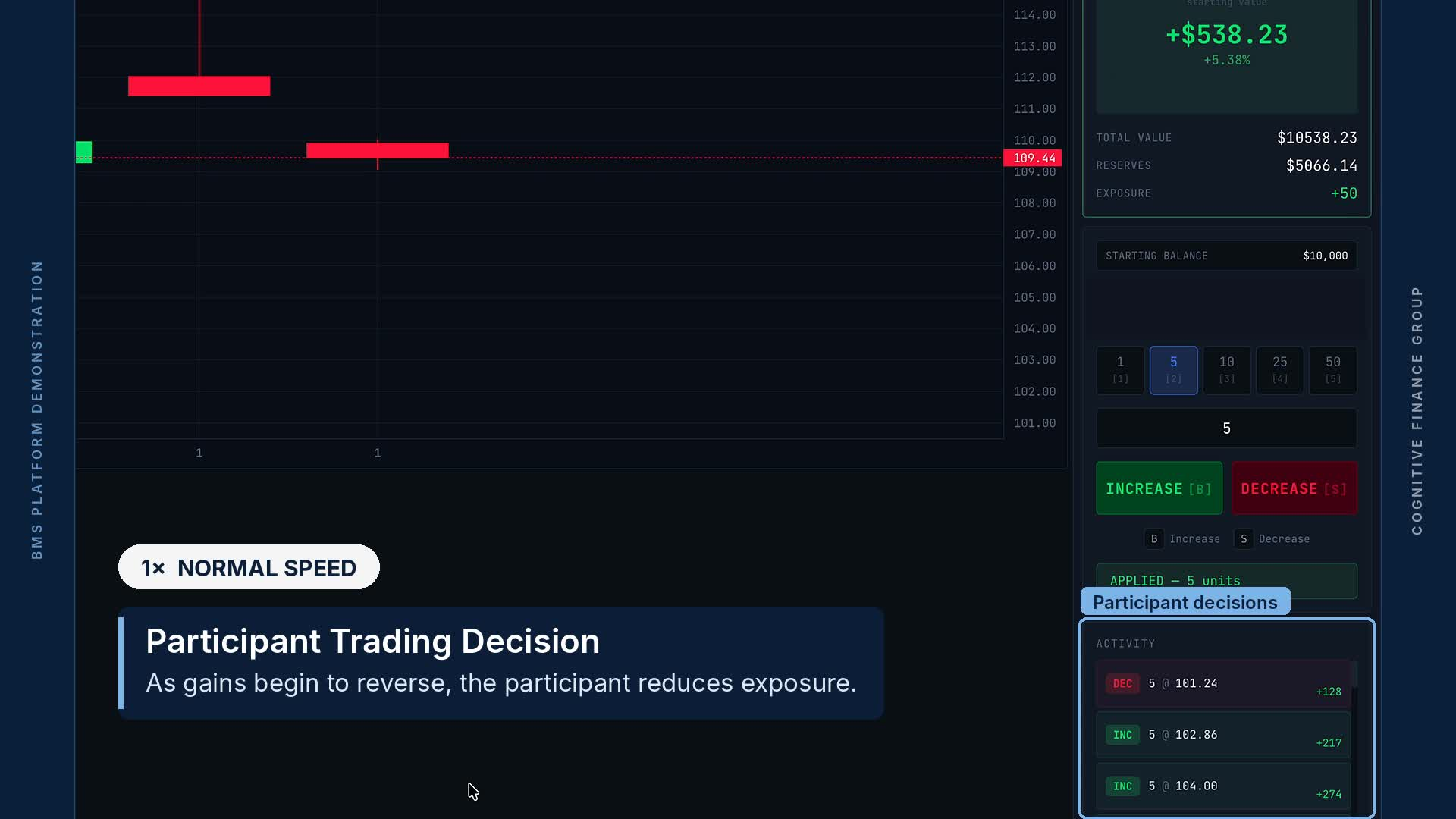
Participant Decision Interface
The trading panel: order-size presets, Increase and Decrease buttons, a confirmation of the applied order, and the activity log.
Real frames from the BMS demonstration video. Simulated activity only; not QU-001 participant data.
Observe, Decide, Record
Participants complete structured simulated trading sessions under defined experimental conditions. In the demonstration session shown above, the on-screen instructions give a $10,000 simulated starting balance and a 10-minute session.
Watch the market
A simulated signal moves over time, including programmed market events.
Adjust exposure
Choose an order size, then press Increase or Decrease.
Log every action
Each decision is recorded with its size, price and running result.
Why a Controlled Simulation?
Final profit or loss doesn’t show how someone reached it. Because researchers set market events in advance, participants can face identical conditions, so differences in their decisions can be compared directly.
What the platform records
- Decision timingEach decision is timestamped relative to market events.
- Exposure adjustmentsEvery increase or decrease, with size and price.
- Responses to market eventsWhat the participant did before, during and after a disruption.
- Rule adherenceWhether actions stay within session rules, such as exposure limits.
Research targets
- Risk control after lossesHow exposure changes after a simulated loss.
- Rule adherenceHow consistently participants follow defined limits.
- Decision consistencyHow decisions vary across comparable conditions.
- Recovery behaviorHow behavior changes after a disruption.
These are research targets, not demonstrated effects. The BMS and its measures have not yet been scientifically validated.
The BMS and QU-001
The BMS is used in the pilot study Neurofeedback Training and Financial Decision Making: A Pilot Study (QU-001).
| Institution | Quinnipiac University |
|---|---|
| Study | QU-001 |
| IRB protocol | #10126 |
| Review | Full Committee |
| Approval date | August 20, 2026 |
| Approval period ends | August 20, 2027 |
Scientific transparency. IRB approval is ethical oversight of the human-participant protocol. It does not demonstrate that the BMS is scientifically validated, or that neurofeedback improves financial decision-making or trading performance.
No QU-001 findings have been reported. All screenshots and video on this page show simulated demonstration activity.
Explore Research Collaboration
The Behavioral Market Simulation is designed to support controlled investigations of financial decision-making. We welcome discussions with U.S.-based academic researchers interested in behavioral finance, decision science, and experimental methodology.
Request a BMS Demonstration